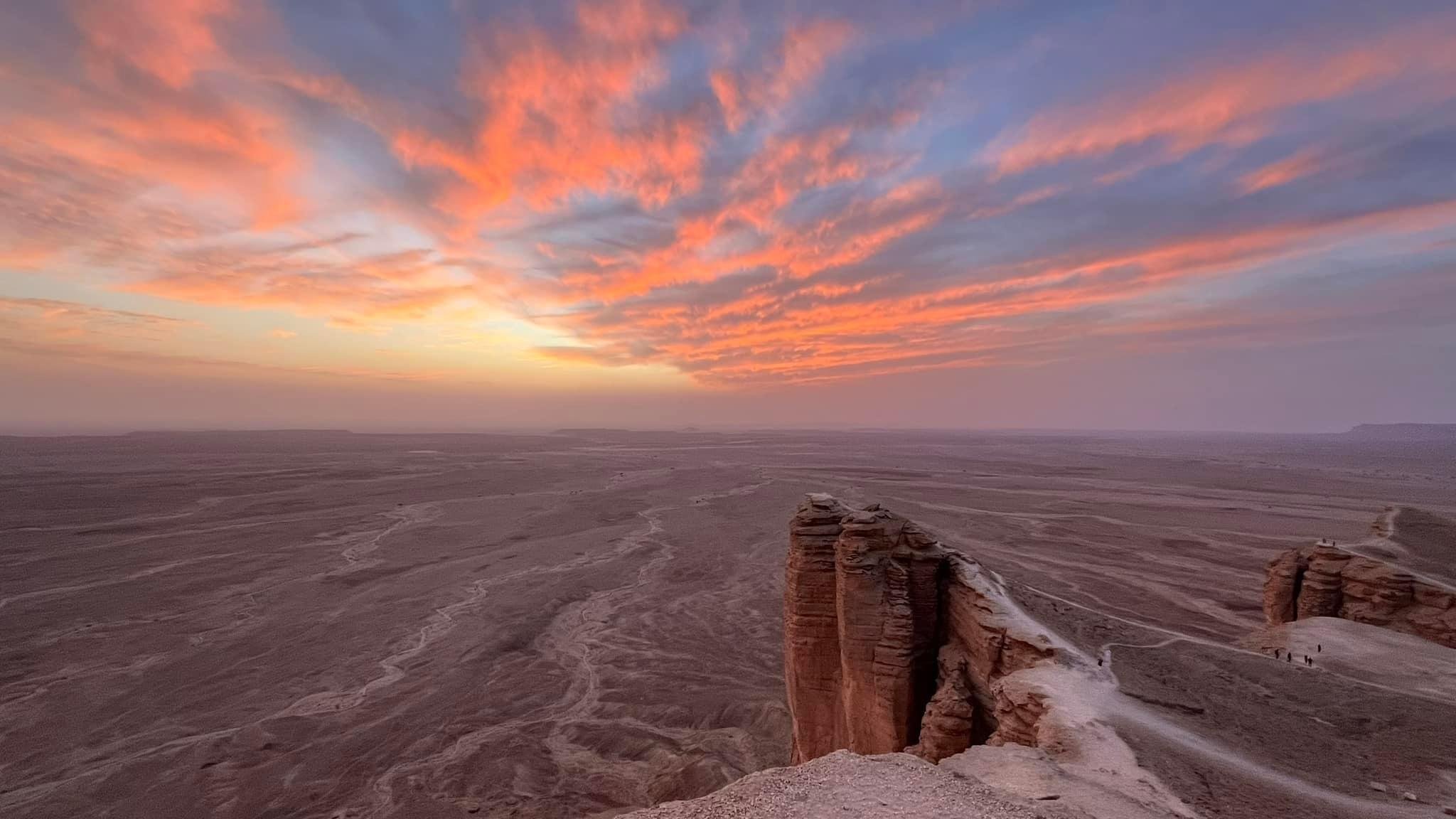
Edge of the World (Jebel Fihrayn): A Riyadh Visitor Guide
The Edge of the World is the cliff where Riyadh's desert day out happens: a Jurassic seabed turned escarpment, an unfenced rim above a plain that runs to the horizon, and a sunset that justifies the two-hour drive out. This guide explains what the place is, how the journey works, and how to decide between sunset, sunrise and doing it yourself.
The questions come down to two: worth it, and how do you do it? The short answers are yes, and with a tour unless you know the desert. The long answers — the geology, the drive, the timing, the kit — are below, and they end where the decision does, on the compared tours page.
What the Edge of the World actually is
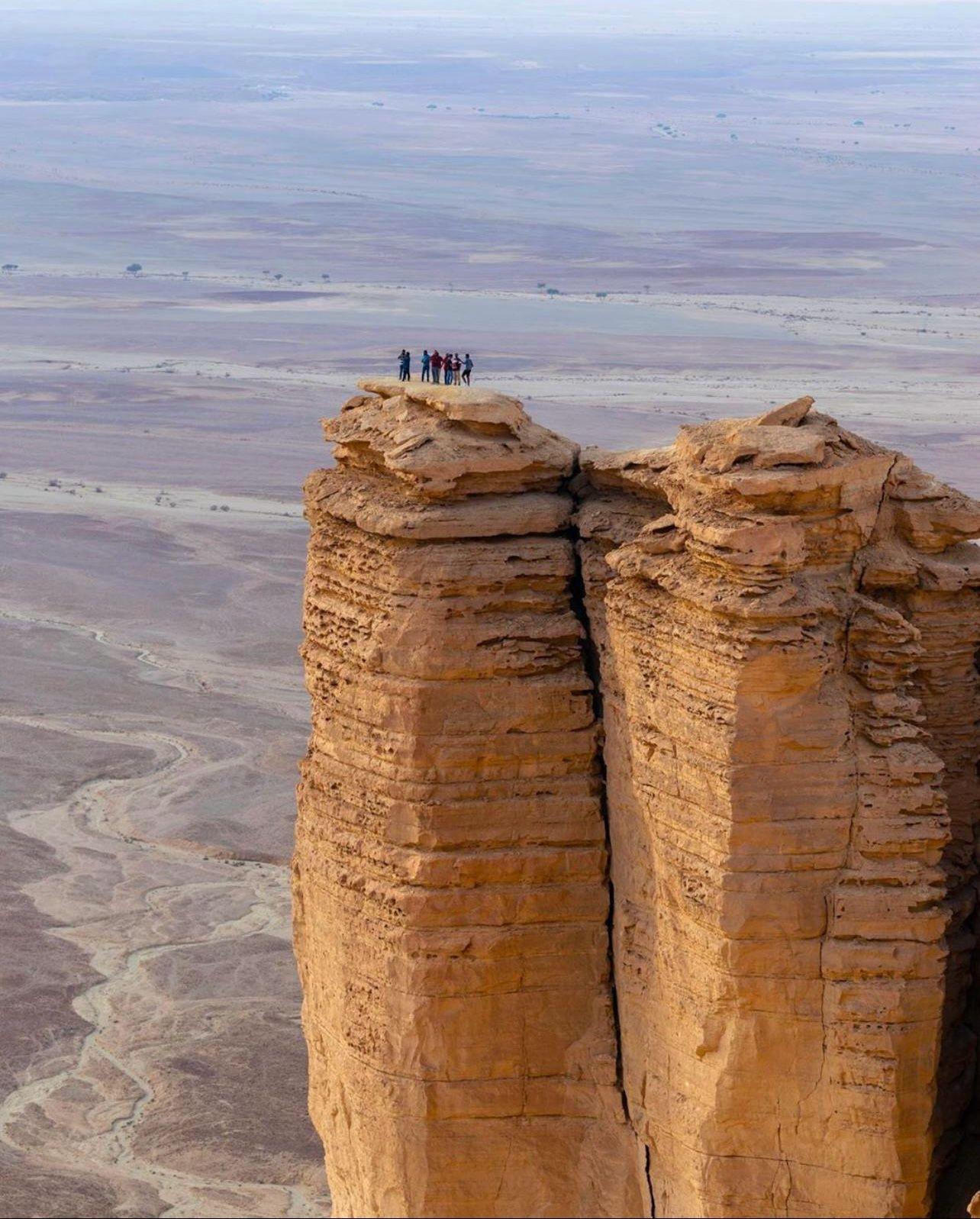
Jebel Fihrayn is the most theatrical break in the Tuwaiq escarpment, the long limestone wall that curves around Riyadh's northwest. Where most of the escarpment crumbles gradually, here it quits all at once: a cliff face dropping from a flat plateau to the basin below, with the rim top sitting at about 1,131 metres above sea level. From the edge, the plain below runs to the horizon with no road, no pole, no structure — the view that earned the English nickname.
An ancient seabed, 165 million years old
The rock under your feet at the Edge of the World is Middle Jurassic limestone — the Tuwaiq Mountain Limestone, laid down around 165 million years ago in the warm shallow sea that then covered this part of the Arabian Peninsula. It is a shelf deposit, which is why the cliffs stack in such clean benches, and it is fossiliferous: corals, ammonites and the trace fossils of animals that crawled that ancient seabed are visible in the rock, and guides on the tours point them out on the walk.
There is a quiet thrill in the geology. The cliff you are standing on was the sea floor, the plain below was the sea itself, and the fossils at your feet were the residents. Few day trips anywhere come with a time machine attached.
Where it is, and the drive out
The site sits 90 to 100 kilometres northwest of Riyadh, and the journey is genuinely part of the day: an hour of highway while the city thins into desert, then the transition to track where the escarpment first appears as a low wall on the horizon and grows until it is the only thing on it. Tours break the drive with stops — a camel farm where the herd comes to the fence, a gazelle reserve where the animals keep their own counsel — and a rest point each way, which matters more than it sounds out there.
Every shared tour states its city departure point up front — a café on Olaya Street, one of three metro stations, a plaza or a square — and the private tour collects you in Riyadh instead. The choice matters more than it looks: it decides how much of your afternoon the logistics consume. The tours page maps our pick's meeting point and lists the rest.
Ready to see it for yourself?
Seven Edge of the World tours from Riyadh, compared — prices from $28, verified meeting points, and every one with free cancellation up to 24 hours before.
Compare Edge of the World toursSunset or sunrise?
Sunset is the classic for good reasons: the afternoon drive runs in kinder light, the rock goes from cream to amber as the sun drops, and staying after dark adds the stargazing — the desert sky away from the city's glow. The shared tours are all built around it, timing the rim walk to end at the edge for the show.
Sunrise is the connoisseur's version — cooler, quieter, pink light instead of gold — and only the private tour compared on the tours page offers it as a choice. The honest trade: sunrise means a pre-dawn departure from the city, which is either the point or the problem, depending on your trip.
What a visit is actually like
Arriving feels like a reveal. The escarpment hides its drop until you are nearly on it, and then the world opens — the plain below, the cliffs running left and right, and a silence with real depth to it. The walk along the rim is light rather than athletic: sandy and rocky ground, pauses for photographs at the protruding rock formations, fossils underfoot, and the guide's word on where to stand, because the edge is unfenced and serious about it.
Plan around two to two and a half hours at the cliffs on the shared tours, wrapped in a six-to-seven-hour arc from the city and back. There are no toilets, shops or shade at the site — the listings say so plainly — so the tour rest stops each way are the infrastructure. After sunset, with Saudi coffee or tea in hand and the sky filling with stars, the day earns its reputation.
What to bring and wear
Closed shoes, sunglasses and a hat are the sensible kit — some listings spell them out, others leave the kit to you — with loose clothing for the heat and a layer for after dark — the desert cools fast once the sun drops, even in the cooler months. Water beyond what you expect to need is the recurring advice, though every compared departure lists refreshments of some kind, from bottled water to Saudi coffee and snacks — the listings spell out what each carries. Cameras and charged phones are simply assumed — the itineraries schedule photo stops, travellers' reviews arrive full of photographs, and the light justifies every frame.
Edge of the World questions
Why is it called the Edge of the World?
Because the plateau literally ends. Jebel Fihrayn is a break in the Tuwaiq escarpment where the flat limestone tableland drops in cliffs to a plain that runs unbroken to the horizon — stand on the rim and the earth looks like it stops. The Arabic name, Jebel Fihrayn, is the mountain's own.
How far is the Edge of the World from Riyadh?
About 90 to 100 kilometres northwest of the city, and the drive runs roughly ninety minutes to two hours each way depending on the route and the last stretch of track. Tour itineraries budget two to two and a half hours door to rim, which is why the shared tours are built as afternoon-to-evening trips.
Can you drive to the Edge of the World yourself?
Locals do, in proper vehicles. The final stretch is gravel and sand track with no signposting, no lighting and no facilities, and a standard rental sedan is the wrong tool — several tours exist precisely because of that drive. If you go independently, take a high-clearance 4×4, offline maps, more water than feels reasonable and someone who has driven it before. The compared tours handle all of it for $28 and up.
Is there an entrance fee?
The site itself is an open natural area, and none of the tour listings prices a separate admission — you pay for the tour, not a gate. Bring cash expectations to zero at the cliff: there is nothing to buy out there, which is part of the point.
Sources
- U.S. Geological Survey — Geology of the Arabian Peninsula, Professional Paper 560-D (Tuwaiq Mountain Limestone)
- University of Texas Bureau of Economic Geology — Tuwaiq Mountain Limestone
- Distances, timings, facilities and meeting points: the operators' GetYourGuide listings, checked 2 October 2026.
Geological ages follow the published surveys of the Tuwaiq Mountain Limestone.